In 1974, two friends from Wisconsin changed the world of gaming forever. Gary Gygax and Dave Arneson's creation, Dungeons & Dragons, didn't just birth a new game—it spawned an entire entertainment medium that would captivate millions and fundamentally alter popular culture's relationship with fantasy.
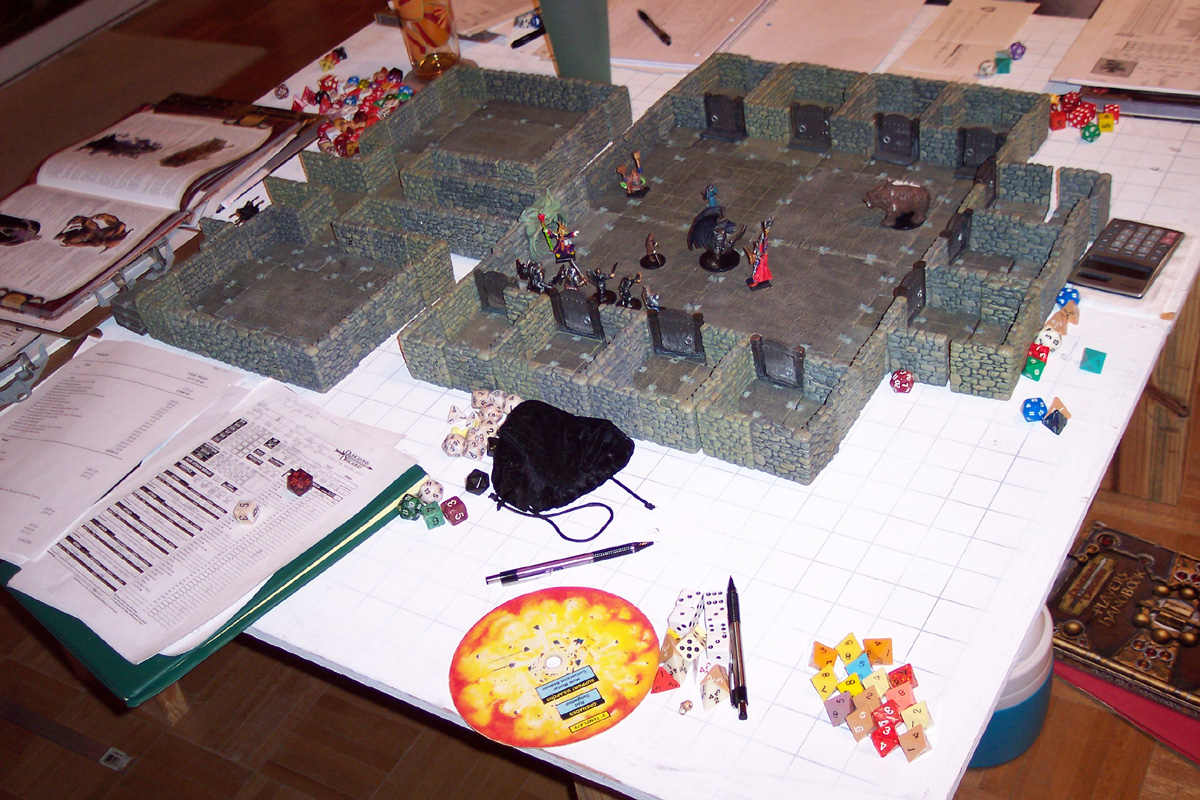
Born from the wargaming community of the early 1970s, D&D represented a radical departure from traditional board games. Instead of moving pieces on a fixed board, players created characters—brave knights, cunning rogues, powerful wizards—and embarked on adventures limited only by imagination and the roll of peculiar polyhedral dice. The game's revolutionary concept was simple yet profound: what if players could become the heroes of their own fantasy stories?
The Birth of Role-Playing
The original Dungeons & Dragons "white box" set, published by TSR (Tactical Studies Rules) in 1974, was a modest affair—three thin booklets that would reshape entertainment forever. Drawing inspiration from pulp fantasy literature, particularly the works of Robert E. Howard, Fritz Leiber, and Jack Vance, Gygax and Arneson created a framework that allowed ordinary people to step into extraordinary roles.
The game's most iconic elements emerged from this first edition: the fearsome dragons that gave the game half its name, mysterious dungeons filled with treasure and peril, and character classes like fighters, magic-users, and clerics. Five evil dragons (white, black, green, blue, and red) and the noble gold dragon first appeared in that original set, establishing the chromatic spectrum that would become synonymous with D&D dragons across all subsequent editions.
What made D&D revolutionary wasn't just its fantasy setting—other games had explored similar themes—but its open-ended nature. Unlike traditional games with fixed objectives and predetermined outcomes, D&D offered infinite possibilities. The Dungeon Master (DM) served as storyteller, referee, and world-builder, while players collaborated to overcome challenges through creative problem-solving, tactical combat, and character development.
Evolution Through the Editions
As D&D grew in popularity throughout the late 1970s and early 1980s, it underwent significant evolution. The Advanced Dungeons & Dragons system, launched in 1977 with the Monster Manual, Player's Handbook, and Dungeon Master's Guide, codified and expanded the rules into a more comprehensive system. This edition introduced the iconic ten dragon types that would become D&D standards: the five chromatic dragons (evil) and five metallic dragons (good), each with distinct personalities, abilities, and breath weapons.
The game's bestiary grew exponentially during this period, introducing legendary creatures that became gaming icons. The beholder—that terrifying floating orb with a central eye and ten smaller eye-stalks—emerged as one of D&D's most recognizable and feared monsters. The carrion crawler, bugbears, and countless other creatures populated an ever-expanding multiverse of adventure possibilities.
Second edition Advanced Dungeons & Dragons, released in 1989, marked a significant shift in both presentation and content. This edition introduced full-color artwork for monsters and more detailed ecological and social information about creatures. The innovative Monstrous Compendium format used loose-leaf pages in binders, allowing players to customize their collections—though this "unruly" system was eventually abandoned in favor of traditional bound books like the Monstrous Manual of 1993.
Cultural Impact and Controversy
D&D's rise to prominence wasn't without turbulence. The game became entangled in the "Satanic Panic" of the 1980s, with critics claiming it promoted occultism and violence. Organizations like Bothered About Dungeons and Dragons (BADD) pushed for restrictions, forcing TSR to temporarily remove devils and demons from the game's mythology. These creatures were later reintroduced with different names to appease critics, demonstrating how external pressures shaped the game's development.
The controversy, while damaging in some ways, also served to publicize D&D more broadly. Law enforcement seminars often grouped D&D alongside genuinely concerning activities in discussions of "ritualistic crime," despite the game's fundamentally collaborative and creative nature. These moral panics reflected broader cultural anxieties about youth culture, fantasy media, and changing social norms.
The Digital Age and Modern Renaissance
The transition to third edition in 2000 marked D&D's entry into the digital age. Wizards of the Coast, which had acquired TSR in 1997, revolutionized the gaming industry with the Open Gaming License, allowing third-party publishers to create compatible content. This democratization of game design led to an explosion of creativity and innovation within the hobby.
Fourth edition (2008) attempted to modernize D&D's mechanics with more tactical, video game-inspired combat, while fifth edition (2014) struck a balance between accessibility and depth that has driven the game's current renaissance. The rise of actual-play shows like Critical Role, combined with increased mainstream acceptance of "geek" culture, has brought D&D to unprecedented heights of popularity.
Today's dragons reflect this evolution: no longer simply good or evil based on color, modern D&D dragons possess complex motivations and personalities. The recent Fizban's Treasury of Dragons expanded the draconic pantheon further, introducing gem dragons and exploring the cosmic significance of dragonkind across the multiverse.
Legacy and Influence
D&D's influence extends far beyond tabletop gaming. It pioneered concepts now standard in video games: character levels, experience points, hit points, and character classes. MMORPGs like World of Warcraft trace their DNA directly back to that original white box. The game's emphasis on collaborative storytelling influenced narrative media, while its democratic approach to world-building anticipated the participatory culture of the internet age.
The game's monster ecology—the careful consideration of how fantastic creatures fit into believable ecosystems—influenced fantasy literature and media production. D&D's systematic approach to magic, with its spell levels and components, became the template for countless fantasy works. Even the humble twenty-sided die, once an obscure mathematical tool, became an instantly recognizable symbol of gaming culture.
"The important thing to remember about D&D is that it's not just a game—it's a framework for imagination. Every dragon slain, every dungeon explored, every friendship forged around the table represents the fundamental human need to create stories together."
From its humble beginnings in Lake Geneva, Wisconsin, to its current status as a global phenomenon, Dungeons & Dragons has proven that the power of imagination, when structured and shared, can create experiences as meaningful as any traditional entertainment medium. The game continues to evolve, but its core promise remains unchanged: in a world of infinite possibilities, anyone can be a hero.
Today, as millions of players worldwide gather around tables both physical and virtual, they participate in a tradition that stretches back fifty years—a testament to the enduring power of collaborative storytelling and the universal appeal of adventure. D&D didn't just create a game; it created a language for imagination itself.
Log in to leave a comment.
No comments yet. Be the first!