
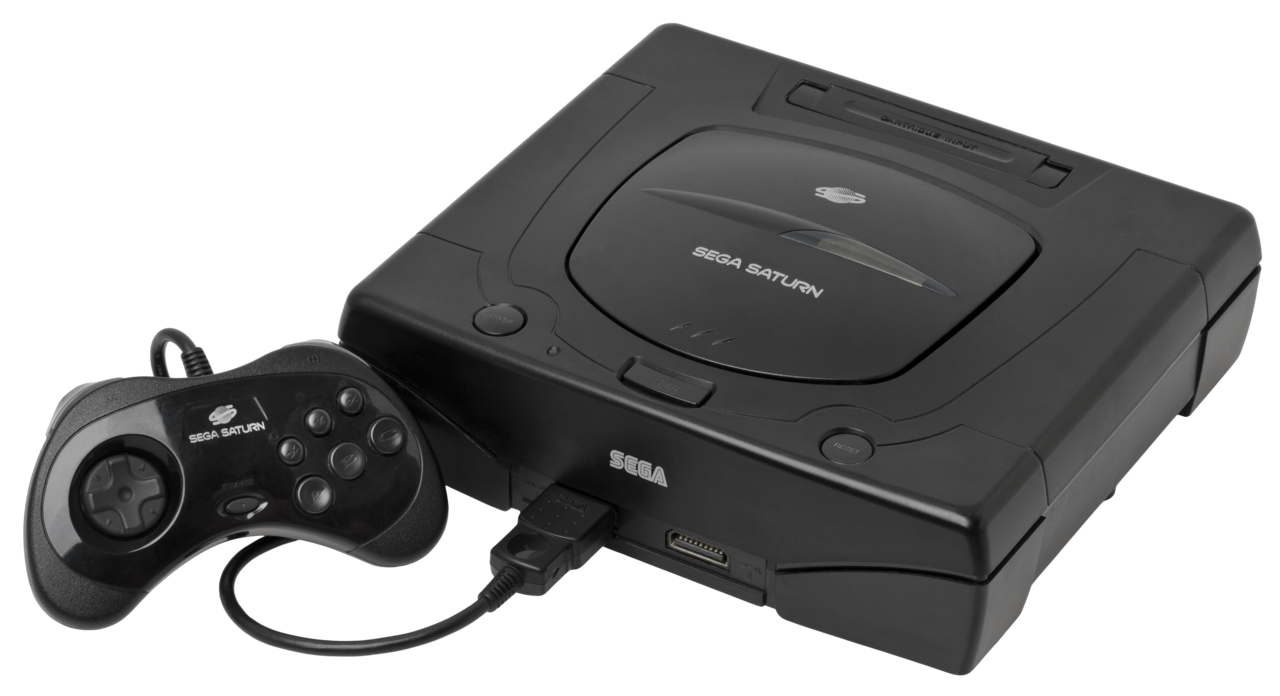
The Sega Saturn stands as one of gaming history's most fascinating contradictions: a technically impressive powerhouse that delivered some of the medium's finest experiences, yet ultimately became a commercial cautionary tale. Released in Japan on November 22, 1994, the Saturn represented Sega's bold attempt to transition from 2D sprite-based gaming to the emerging world of 3D polygons, but its complex architecture and strategic missteps would ultimately define its legacy as much as its remarkable software library.
The Genesis of Ambition
Coming off the success of the Sega Genesis, Sega entered the mid-90s with confidence and momentum. The company had proven it could compete with Nintendo through aggressive marketing and the undeniable appeal of Sonic the Hedgehog. Meanwhile, their arcade division was pushing boundaries with the revolutionary Model 1 system board, showcasing technical marvels like Virtua Racing and Virtua Fighter—the first true 3D fighting game.
Under the supervision of Hideki Sato, Sega's director of research and development, the Saturn project began in earnest over two years before its public unveiling at the Tokyo Toy Show in June 1994. The development team, led by project manager Hideki Okamura, faced the challenge of creating hardware that could bridge Sega's sprite-based legacy with the polygon-driven future.
A Tale of Two Processors
The Saturn's most defining characteristic—and perhaps its greatest strength and weakness—was its dual Hitachi SuperH RISC Engine (SH-2) processor architecture. As Kazuhiro Hamada, Sega's section chief for Saturn development, explained: "The SH-2 was chosen for reasons of cost and efficiency. The chip has a calculation system similar to a DSP, but we realized that a single CPU would not be enough to calculate a 3D world."
This dual-processor setup was complemented by an impressive array of specialized chips, giving the Saturn a total of eight processors working in concert. The system featured two custom video display processors (VDP1 and VDP2), each running at 28.6 MHz, designed to handle both 2D sprites and 3D polygons with equal aplomb. When Sony's PlayStation specifications became known in early 1994, Sega added a second VDP to improve the Saturn's 3D capabilities and texture mapping—a decision that would make the system incredibly powerful but notoriously difficult to program.
The Surprise That Backfired
The Saturn's launch strategy would become a masterclass in how not to release a console. Originally scheduled for "Saturnday" (Saturday), September 2, 1995, in North America, Sega of Japan mandated an early launch to gain an advantage over Sony's PlayStation. At the inaugural E3 in Los Angeles on May 11, 1995, Tom Kalinske, CEO of Sega of America, shocked attendees by announcing that 30,000 Saturns were already shipping to select retailers for immediate release at $399.
This surprise launch backfired spectacularly. Major retailers like Best Buy, Walmart, and KB Toys were blindsided by the announcement, with KB Toys going so far as to refuse to carry the Saturn and its games entirely. The limited retail presence meant only six launch games were available, all published by Sega, as third-party developers hadn't prepared for the earlier date.
Sony's response was swift and devastating. At the same E3, Olaf Olafsson summoned Sony Computer Entertainment America's Steve Race to the stage, who simply said "Two ninety-nine" (referring to the PlayStation's $299 price point) and walked away to thunderous applause. The $100 price difference would prove crucial in the American market.
A Library of Legends
Despite its commercial struggles, the Saturn housed an extraordinary software library that showcased the system's unique capabilities. The platform launched in Japan with Virtua Fighter, a pixel-perfect port of Sega's groundbreaking arcade fighting game that sold at nearly a one-to-one ratio with the console itself. This technical achievement demonstrated what the Saturn could accomplish when developers learned to harness its complex architecture.
The Saturn became home to some of the most beloved and innovative games of the fifth generation. Sonic Team's NiGHTS into Dreams offered a dreamlike flight experience that couldn't be replicated elsewhere. The Panzer Dragoon series, developed by the newly formed Team Andromeda, combined rail-shooting action with breathtaking visuals and Savin Yeatman-Eiffel's haunting musical scores. Virtua Fighter 2, running at a silky-smooth 60 frames per second, remained the definitive home version of Sega's premier fighting franchise.
Other standouts included the frantic shoot-em-ups Radiant Silvergun and Guardian Heroes, the atmospheric horror of D and Enemy Zero, and innovative puzzle games like Puyo Puyo Sun. The Saturn also excelled at 2D gaming, with pixel-perfect arcade ports and original titles that showcased the system's sprite-handling capabilities.
The Japanese Exception
While the Saturn struggled in Western markets, it found considerably more success in Japan, where it sold 5.75 million of its worldwide total of 9.26 million units. Japanese developers and consumers appreciated the system's 2D capabilities and unique software library, with many games never leaving the Japanese market. The Saturn's library includes 1,028 official releases, with an astounding 775 games (75% of the total library) remaining Japan-exclusive.
This regional divide highlighted cultural differences in gaming preferences and the Saturn's positioning. Where Western markets increasingly favored 3D experiences like those found on the PlayStation and Nintendo 64, Japanese players continued to embrace 2D gaming, visual novels, and the unique experiences that only appeared on Saturn.
Technical Triumphs and Challenges
The Saturn's complex architecture was both its greatest strength and most significant weakness. When properly programmed, the system could produce stunning results that often surpassed its competition. Sega Rally Championship showcased realistic driving physics and detailed environments, while Virtua Cop pioneered console light-gun gaming with arcade-perfect precision.
However, the system's complexity made it notoriously difficult to develop for, especially compared to the more straightforward PlayStation architecture. Many third-party developers struggled to extract the Saturn's full potential, resulting in inferior ports of multiplatform games. This technical barrier contributed to reduced third-party support, particularly in Western markets where such partnerships were crucial for success.
The Road to Extinction
Several factors contributed to the Saturn's commercial failure. The surprise launch alienated retailers and limited software availability. The higher price point compared to the PlayStation created an immediate disadvantage. Most critically, the cancellation of Sonic X-treme—intended as the first true 3D Sonic game—left the Saturn without its most important exclusive franchise.
The arrival of Nintendo's 64-bit console in late 1996 further complicated matters, creating a three-way battle that the Saturn was ill-equipped to fight. By 1998, Sega had discontinued the Saturn in Western markets, though it continued in Japan until 2000. The company's focus had already shifted to its next console, the Dreamcast, which would launch in 1998 with valuable lessons learned from the Saturn's struggles.
A Complex Legacy
Today, the Sega Saturn is remembered with the complicated affection reserved for ambitious failures. Its technical achievements were genuine—the system pushed boundaries and enabled experiences that couldn't be found elsewhere. Its software library, while largely confined to Japan, contained genuine masterpieces that influenced game design for years to come.
The Saturn's failure taught the industry valuable lessons about hardware design, third-party relations, and marketing strategy. It demonstrated that technical superiority alone couldn't guarantee success, and that developer-friendly architecture often mattered more than raw processing power. These lessons would influence not only Sega's approach with the Dreamcast but the entire industry's understanding of console development.
For collectors and enthusiasts, the Saturn represents a treasure trove of unique experiences. Its games command high prices on the secondary market, and the system has found new life through modern FPGA recreations and official mini-console releases. The Saturn may have lost the console war of its generation, but it won the hearts of those who experienced its singular magic.
In the broader narrative of gaming history, the Sega Saturn serves as a reminder that innovation and ambition, while admirable, must be balanced with practical considerations of cost, complexity, and market realities. It stands as both a testament to Sega's creative vision and a cautionary tale about the perils of overengineering in a rapidly evolving industry.
Log in to leave a comment.
No comments yet. Be the first!