
In the annals of gaming history, few consoles have had as profound an impact on the industry as the Sega Mega Drive—known as the Genesis in North America. This 16-bit powerhouse didn't just represent a technological leap forward; it fundamentally changed how video games were marketed, perceived, and played. More than three decades after its Japanese debut, the Mega Drive stands as a testament to bold engineering, aggressive marketing, and the kind of cultural lightning that can transform an entire medium.
Genesis of a Revolution
The Mega Drive's story begins in the aftermath of Sega's struggles with the Master System. Despite technical superiority over Nintendo's 8-bit Famicom, the Master System had failed to make significant inroads in the Japanese and North American markets. By 1987, with the PC Engine generating buzz in Japan, Sega's R&D team knew they needed something special to compete with the established giants.
Under the supervision of Hideki Sato and led by Masami Ishikawa, the development team made a crucial decision: they would adapt Sega's successful System 16 arcade board for home use. This wasn't just about creating another console—it was about bringing the arcade experience home with unprecedented fidelity. The heart of this vision was the Motorola 68000 processor, the same chip powering many of the era's most sophisticated computers and arcade machines.
The 68000 was expensive—prohibitively so for a consumer device. But Sega's negotiation with distributors for bulk orders at a fraction of the standard price would prove to be one of the most important business decisions in gaming history. Paired with a Zilog Z80 for sound processing and custom graphics chips supporting hardware sprites, tiles, and scrolling, the Mega Drive represented a quantum leap in home gaming power.
Design Philosophy and Cultural Impact
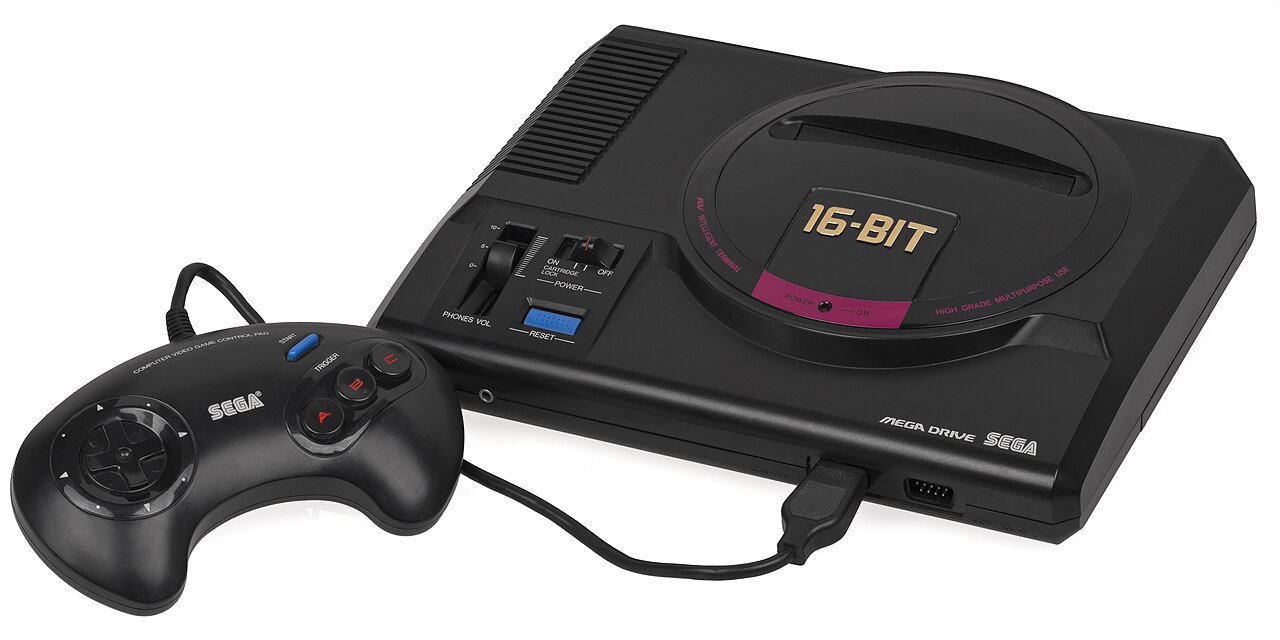
The Mega Drive's distinctive appearance was no accident. Designed by a team led by Mitsushige Shiraiwa, the console drew inspiration from high-end audio equipment and automotive design. The sleek black chassis with its golden "16-bit" embossing wasn't targeting children—it was courting teenagers and adults who had grown up with video games and were ready for something more sophisticated.
This mature aesthetic philosophy extended to the console's marketing and game library. Where Nintendo maintained a family-friendly image, Sega positioned itself as the cool alternative. The famous "Genesis does what Nintendon't" campaign wasn't just advertising hyperbole—it represented a fundamental shift in how video game companies could position themselves in the market.
Launch and Regional Variations
The Mega Drive launched in Japan on October 29, 1988, though it faced immediate challenges from Nintendo's Super Mario Bros. 3, which had debuted just a week earlier. Despite positive coverage in Famitsu and Beep! magazines, and selling out its initial production run within two days, the console struggled to find its footing in its home market.
North America told a different story. After Atari declined to distribute the system (a decision that would haunt Jack Tramiel for years), Sega launched the Genesis through its own American subsidiary in August 1989. The name change from "Mega Drive" to "Genesis" was necessitated by trademark issues, but as Sega of America's David Rosen noted, it represented "a new beginning" for the company in the region.
Europe received the Mega Drive in September 1990 through Virgin Mastertronic, priced at £189.99. The European launch proved particularly successful, with the console eventually becoming the best-selling fourth-generation system in the region. Launch titles included arcade favorites like Golden Axe, Ghouls 'n Ghosts, and The Revenge of Shinobi, immediately establishing the console's arcade credentials.
The Console Wars Begin
The arrival of Nintendo's Super Nintendo Entertainment System in 1991 triggered what became known as the "console wars"—a marketing battle that would define gaming culture for the better part of a decade. Sega's aggressive marketing tactics, epitomized by campaigns featuring attitude-heavy slogans and direct attacks on Nintendo's "kiddie" image, brought video games into the cultural mainstream in an unprecedented way.
The console wars weren't just about hardware specifications or game libraries—they were about identity. Choosing a Genesis meant aligning yourself with rebellion, speed, and attitude. This positioning was crystallized perfectly in Sonic the Hedgehog, the blue blur who became Sega's answer to Mario. Where Nintendo's mascot was methodical and family-friendly, Sonic embodied the "blast processing" philosophy that Sega used to market the Genesis's technical capabilities.
Technical Innovation and Expansion
Beyond its impressive base specifications, the Mega Drive became a platform for innovation through its various add-ons and peripherals. The Power Base Converter allowed backward compatibility with Master System games, while network services like Sega Meganet in Japan and the Sega Channel in North America presaged the online gaming revolution by decades.
The Sega CD (Mega-CD outside North America) represented an ambitious attempt to leverage the emerging compact disc technology. While it never achieved mainstream success, it showcased full-motion video capabilities and CD-quality audio that wouldn't become standard until the next generation. Similarly, the 32X peripheral attempted to extend the console's lifespan with 32-bit processing power, though it ultimately contributed to the hardware fragmentation that confused consumers.
The Legal Battleground
The Mega Drive's success attracted legal scrutiny that would shape the entire industry. The landmark Sega v. Accolade case established crucial precedents for reverse engineering and fair use in software development. When Accolade reverse-engineered Sega's games to create compatible titles without licensing agreements, Sega sued for copyright and trademark infringement.
The case hinged on Accolade's discovery and use of the TMSS (Trademark Security System) initialization code—a four-byte sequence spelling "SEGA" that newer Genesis consoles required for compatibility. The Ninth Circuit Court of Appeals ultimately ruled in favor of Accolade, establishing that reverse engineering for interoperability constituted fair use under copyright law. This decision had far-reaching implications for software development and competition throughout the technology industry.
Cultural Legacy and Violence Controversy
The Mega Drive's positioning as the more mature gaming platform inevitably led to controversy. Games like Mortal Kombat and Night Trap drew criticism from politicians and advocacy groups concerned about video game violence. Unlike Nintendo, which censored Mortal Kombat's fatalities, Sega released the uncensored version with a content warning—a decision that boosted sales but intensified scrutiny.
This controversy culminated in Congressional hearings in 1993, leading to the creation of the Entertainment Software Rating Board (ESRB). Sega's proactive stance, including the formation of the Videogame Rating Council as a precursor to the ESRB, demonstrated the company's willingness to engage with cultural concerns while defending artistic expression in games.
Global Success and Regional Variations
While the Mega Drive struggled in Japan against the Super Famicom and PC Engine, it found tremendous success in other markets. In North America, it achieved rough parity with the Super Nintendo, while in Europe and Brazil, it dominated the 16-bit generation. These regional differences reflected not just marketing strategies but cultural preferences and local business partnerships.
The console's success in Brazil, where Tectoy continues to manufacture and sell Mega Drive systems to this day, illustrates its enduring global appeal. With over 3 million units sold by Tectoy alone, and official sales exceeding 30 million units worldwide, the Mega Drive achieved the commercial success that had eluded Sega's previous consoles.
The Software Library
The Mega Drive's game library of over 880 officially licensed titles represented unprecedented diversity for a console. While Sonic became the system's mascot, games like Streets of Rage, Phantasy Star, and Ecco the Dolphin showcased the platform's range. The console's arcade heritage meant that action games often felt more immediate and visceral than their Nintendo counterparts.
Sports games became a particular strength, with titles like Joe Montana Football and the EA Sports lineup helping establish annual franchises that continue today. The mature marketing also allowed for more adult-oriented titles, expanding the potential audience for home video games beyond traditional demographics.
End of an Era
By 1997, the Mega Drive's commercial run had ended in most markets, succeeded by Sega's ill-fated Saturn console. However, the system's cultural impact continued to reverberate. Licensed third-party releases by companies like AtGames kept the hardware available for new generations, while compilations and digital re-releases introduced classic games to modern platforms.
The console's influence extends far beyond its sales figures or technical specifications. It proved that direct competition could drive innovation, that mature marketing could expand gaming demographics, and that platform holders could challenge established market leaders through superior technology and bold positioning. The Mega Drive didn't just compete with Nintendo—it forced the entire industry to evolve, setting the stage for the diverse, competitive gaming landscape we know today.
Log in to leave a comment.
No comments yet. Be the first!