
December 10, 1993. A date burned into gaming history as surely as the plasma rifle burns through demons. That's when id Software released DOOM as shareware, and nothing was ever the same again.
If you were there—if you remember the anticipation, the whispered rumors about what John Carmack's new engine could do, the desperate search for a PC that could actually run it—then you know. DOOM wasn't just a game. It was a revelation.
The Setup Was Simple, The Impact Volcanic
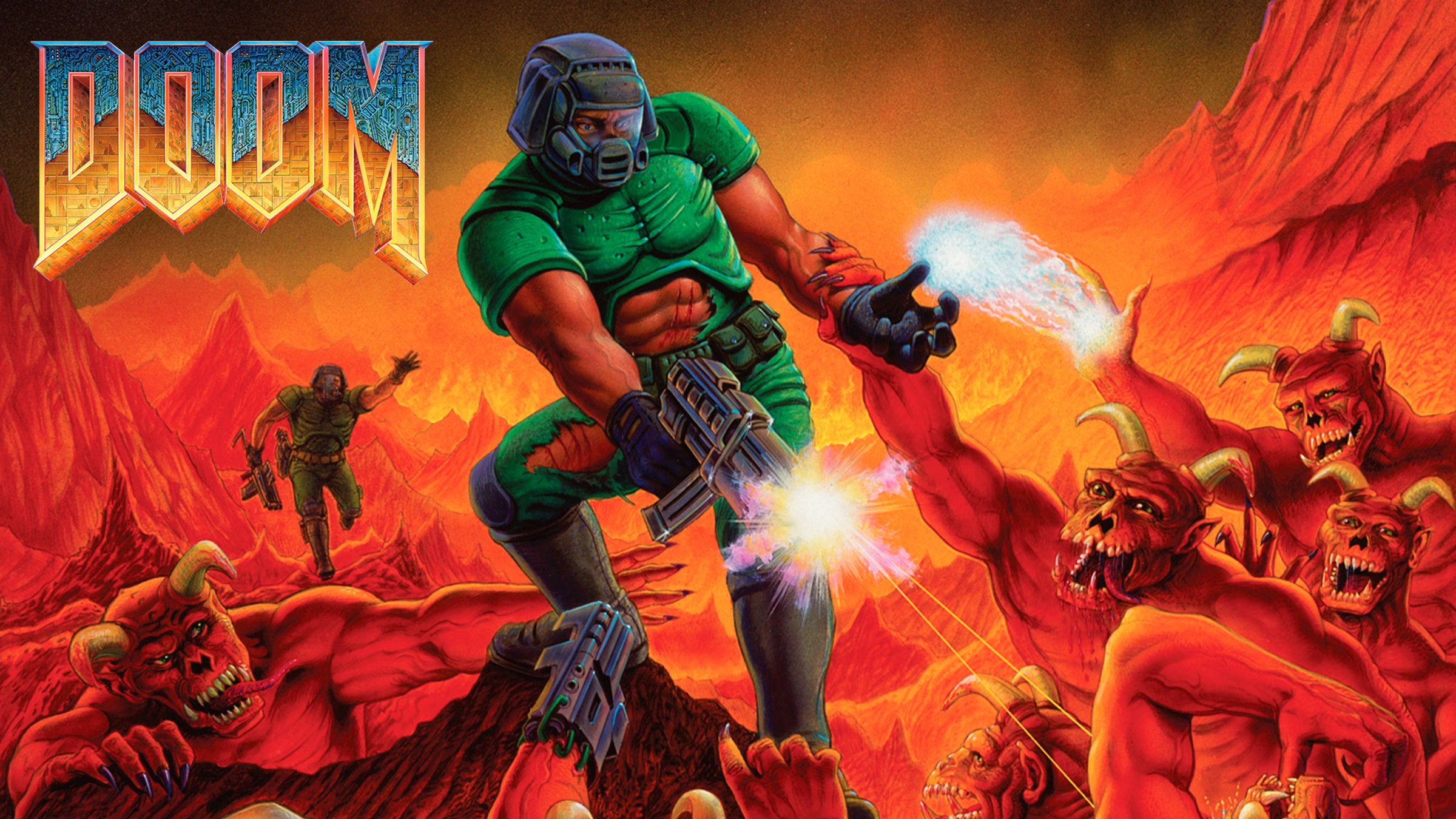
You played as an unnamed space marine (later dubbed "Doomguy" by fans) stationed on Mars. When teleportation experiments go wrong and demons pour through from Hell, you're the lone survivor with nothing but a pistol and an attitude. The plot was paper-thin by design—John Carmack famously said "Story in a game is like story in a porn movie; it's expected to be there, but it's not that important." He wanted pure, distilled action, and that's exactly what we got.
But oh, what action it was. DOOM's revolutionary engine created something that felt like magic in 1993. While technically using "2.5D" graphics—3D environments with 2D sprites for enemies and objects—it delivered an experience that felt completely three-dimensional. You could look up, you could look down, you could run through corridors that twisted and turned in ways that made Wolfenstein 3D look positively primitive.
The Weapons Were Everything
Let's talk about that arsenal. The pistol was serviceable, the shotgun was satisfying, but then came the chainsaw. The chainsaw. Who thought to give a space marine a chainsaw in a sci-fi horror game? It was gloriously, absurdly perfect. The plasma rifle hummed with alien energy, and then there was the BFG 9000—a weapon so legendarily overpowered that its very name became gaming shorthand for "ridiculously huge gun."
Each weapon had weight, personality, and purpose. The Super Shotgun in DOOM II became the stuff of legend, but even in the original, every gun felt necessary and distinct. You weren't just collecting weapons; you were building an arsenal of demon-slaying perfection.
The Demons Were Iconic
Adrian Carmack's demon designs were masterful. The pink Demon (or "Pinky" as fans called it) with its distinctive bite. The floating Cacodemon with its cyclopean eye and massive maw. The towering Cyberdemon, part machine, part monster, all nightmare fuel. And who could forget the imp, with its distinctive fireball attacks and that unforgettable death rattle?
These weren't just obstacles—they were characters in their own right. Each had distinct behaviors, sounds, and tactical implications. The Baron of Hell that closed out the first episode felt genuinely intimidating, while the Spider Mastermind finale was a bullet-sponge boss battle that tested every skill you'd learned.
The Technology Was Revolutionary
But DOOM's true genius wasn't just in its content—it was in its technology. Carmack's engine was a quantum leap forward, delivering smooth, fast gameplay on hardware that seemed inadequate just months earlier. A 486 DX2/66 could run DOOM at playable framerates, bringing arcade-quality action to home PCs for the first time.
The game's "2.5D" approach was brilliant engineering. By restricting movement to a 2D plane while rendering everything in pseudo-3D, DOOM achieved visual complexity that true 3D engines wouldn't match for years. Rooms could be above other rooms, floors could move, ceilings could crush—all impossible in Wolfenstein 3D's grid-based world.
Multiplayer Changed Gaming Forever
And then there was multiplayer. DOOM's deathmatch mode—the term itself coined by id Software—turned office networks into battlegrounds. Four players could connect via IPX protocol and hunt each other through those familiar corridors. Cooperative mode let friends tackle Hell together, sharing resources and watching each other's backs.
This wasn't just a feature—it was the birth of online gaming culture as we know it. DWANGO (Dial-up Wide Area Network Game Operation) emerged to connect players across phone lines. The concept of "fragging" entered the lexicon. Gaming went from solitary to social in ways that echo through every online shooter today.
The Shareware Model Was Genius
Id Software's distribution strategy was as revolutionary as the game itself. They released the first episode, "Knee-Deep in the Dead," as free shareware, letting anyone copy and distribute it. Want episodes two and three ("The Shores of Hell" and "Inferno")? Buy the full game. It was brilliant marketing that reached far beyond traditional retail channels.
Suddenly, DOOM was everywhere. University networks groaned under the traffic. Offices became less productive. The game spread like a virus, which was exactly the point. By the time "The Ultimate DOOM" arrived in 1995 with the additional fourth episode "Thy Flesh Consumed," the franchise was unstoppable.
The Controversy Was Real
DOOM's graphic violence sparked genuine moral panic. This wasn't abstract space invaders dying—these were detailed, bloody deaths in realistic environments. The chainsaw didn't just defeat enemies; it painted the walls red. Religious groups condemned it as satanic. Politicians blamed it for societal violence.
But for players, the violence felt cathartic rather than disturbing. You weren't the aggressor—you were humanity's last hope against literal demons from Hell. The over-the-top gore was part of the dark humor, the B-movie sensibility that made DOOM feel like playing through an Evil Dead film.
The Modding Scene Exploded
DOOM's open architecture invited modification in ways no game had before. When id released the source code years later, the modding scene went supernova. WAD files (Where's All the Data) let players create new levels, new graphics, new total conversions. DOOM became a platform rather than just a game.
Speedrunning found its home in DOOM's precisely timed levels. Players discovered secrets, shortcuts, and exploits that let them complete levels in impossible times. The competitive scene that emerged around DOOM demos laid groundwork for esports decades before the term existed.
The Legacy Is Immeasurable
By 1995, an estimated 20 million people had played DOOM. That number seems modest by today's standards, but in 1995, it was revolutionary. DOOM proved that PCs could be gaming machines. It established the template for first-person shooters that persists today. It created online gaming culture. It birthed the modding community. It sparked moral debates about video game content that continue today.
More than that, DOOM changed how we thought about interactive entertainment. Here was a game that felt dangerous, transgressive, powerful. It wasn't trying to be respectable or educational—it was pure id, pure gaming joy distilled into its most potent form.
Why It Still Matters
Play DOOM today—the original, not the (admittedly excellent) modern reboots—and it still feels vital. The gameplay is immediate and pure. The level design is intricate and clever. The weapons feel powerful. The demons still snarl with menace. Strip away three decades of graphical advancement, and the core experience remains as compelling as ever.
DOOM proved that video games could be art, entertainment, technology showcase, and cultural phenomenon all at once. It launched careers, built companies, and inspired countless imitators. But most importantly, it was just an absolute blast to play.
Whether you experienced DOOM's initial impact or discovered it later, whether you remember the thrill of finding the chainsaw for the first time or the satisfaction of perfect circle-strafing, you know the truth: DOOM wasn't just a great game. It was gaming's big bang moment, the explosion that created the universe we're still playing in today.
And if you've never played it? Well, DOOM runs on everything now—literally everything. There's no excuse not to experience the game that changed gaming forever. Just remember to save your progress. You're going to need it.
Log in to leave a comment.
No comments yet. Be the first!