
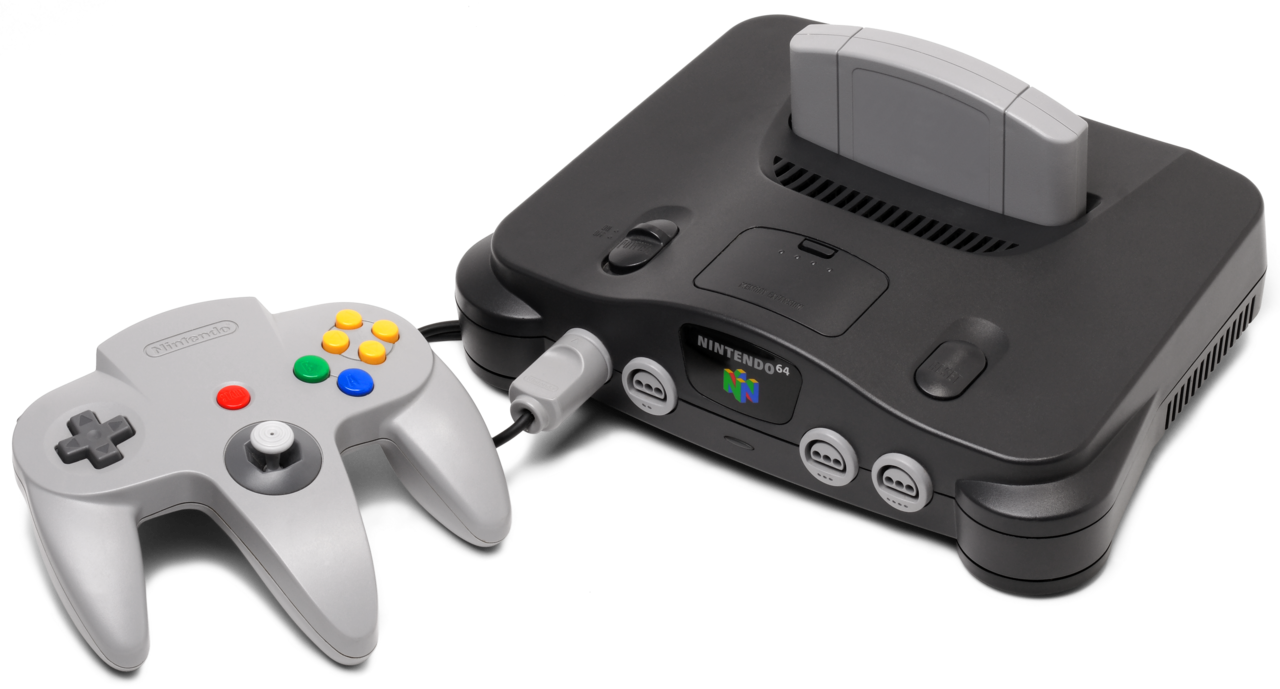
In the annals of gaming history, few consoles carry the weight of legacy quite like the Nintendo 64. Released on June 23, 1996, in Japan, this charcoal-gray powerhouse marked Nintendo's bold leap into the world of 3D gaming—and became the last major cartridge-based home console until the Nintendo Switch arrived over two decades later.
The N64's journey began in 1993 as "Project Reality," a collaboration between Nintendo and Silicon Graphics Inc. (SGI), a company better known for Hollywood special effects than home gaming. This unlikely partnership would produce what Time magazine declared the "Machine of the Year" in 1996, fundamentally reshaping how we interact with virtual worlds.
The Silicon Graphics Revolution
SGI's involvement wasn't accidental—the company was looking to break into the consumer market after dominating high-end workstations. Their pitch was audacious: bring supercomputing graphics power to living rooms for under $250. The core technology, dubbed "Reality Immersion Technology," featured a 64-bit NEC VR4300 processor running at 93.75 MHz paired with SGI's custom Reality Coprocessor for graphics and sound.
Early development was surreal. Game studios worked on $250,000 SGI Onyx supercomputers to simulate the console's expected performance. LucasArts famously ported a prototype Star Wars game to the final hardware in just three days—a testament to SGI's accurate performance predictions.
The console's distinctive three-pronged controller became gaming's first to feature an analog stick as standard equipment. This wasn't just an add-on—it was the future of 3D control, allowing players to navigate virtual spaces with unprecedented precision. Four controller ports meant multiplayer gaming reached new heights, turning living rooms into battlegrounds for GoldenEye 007 and Mario Kart 64.
The Cartridge Gambit
Nintendo's most controversial decision was sticking with ROM cartridges when the industry was embracing CD-ROMs. While Sony's PlayStation loaded games from discs, Nintendo doubled down on silicon. The reasoning was sound: cartridges offered instant loading, prevented piracy, and provided superior reliability. But this choice would define the N64's entire legacy—for better and worse.
Cartridges cost significantly more to manufacture than CDs, forcing higher game prices and smaller profit margins for developers. Storage limitations meant complex games required expensive memory management tricks. These constraints drove away third-party publishers like Squaresoft, who moved Final Fantasy VII to PlayStation partly due to the N64's storage limitations.
Yet cartridges enabled experiences impossible on disc-based systems. Games like Super Mario 64 featured seamless world transitions, while The Legend of Zelda: Ocarina of Time delivered sprawling adventures without loading screens. The format's speed advantages became apparent in fast-paced multiplayer games where every millisecond mattered.
Technical Innovation and Accessories
The N64's expandability set it apart from competitors. The Expansion Pak doubled system RAM from 4MB to 8MB, enabling enhanced graphics and entirely new gameplay possibilities. Games like Donkey Kong 64 and The Legend of Zelda: Majora's Mask required the upgrade, while others like Perfect Dark locked substantial content behind it.
The Rumble Pak, bundled with Star Fox 64, introduced force feedback to console gaming. Suddenly, players could feel explosions, crashes, and impacts. This tactile revolution influenced controller design for generations, though the N64's implementation required sacrificing one of the controller's accessory ports.
Other accessories pushed boundaries: the Transfer Pak connected Game Boy games to console experiences, the Voice Recognition Unit enabled primitive speech commands in Hey You, Pikachu!, and the Japan-exclusive 64DD promised internet connectivity and magnetic disk storage—though it failed commercially.
The Software Library
Despite attracting fewer third-party developers than PlayStation, the N64 boasted an enviable first-party lineup. Super Mario 64 redefined 3D platforming with its revolutionary analog controls and camera system. The Legend of Zelda: Ocarina of Time perfected the action-adventure formula with Z-targeting and context-sensitive controls. GoldenEye 007 proved console shooters could rival PC experiences while pioneering split-screen multiplayer.
Nintendo's partnership with Rare proved particularly fruitful. The British developer delivered Banjo-Kazooie, Perfect Dark, and Donkey Kong 64, each showcasing the hardware's capabilities. Meanwhile, Nintendo's internal teams crafted Super Smash Bros., Mario Kart 64, and Paper Mario—games that remain franchise pinnacles decades later.
The system's 388-game library was smaller than PlayStation's massive catalog, but it punched above its weight in quality. Many N64 titles appear on "greatest games ever" lists, their influence still felt in modern game design.
Market Performance and Legacy
Commercially, the N64 occupied middle ground in the fifth console generation. Its 32.93 million units sold worldwide placed it ahead of Sega Saturn but well behind PlayStation's dominant 102 million. North America embraced the system (20.63 million units), while Japan and Europe proved more challenging markets.
Nintendo's decision to prioritize cartridges ultimately cost them market leadership, but it preserved their reputation for quality. Every N64 game worked immediately, while early PlayStation owners dealt with loading times and disc read errors. This reliability became a Nintendo trademark, influencing design philosophy through the GameCube and Wii eras.
The End of an Era
Nintendo discontinued the N64 in 2002, transitioning to the GameCube's miniDVD format. The move acknowledged industry reality: optical media had won the storage war. Yet the N64's influence persisted in analog controls, force feedback, four-player gaming, and 3D design principles that became industry standards.
Today, the Nintendo 64 represents a unique moment in gaming history—when technological ambition, creative vision, and stubborn adherence to principles created something truly special. Its cartridge format seems quaint now, but in 1996, it enabled experiences that felt like magic. The N64 didn't just play games; it transported players to new dimensions, one analog stick movement at a time.
In retrospect, video game journalists consistently rank the N64 among the most influential consoles ever created. Its library spawned countless sequels, its controller innovations became industry standard, and its emphasis on local multiplayer gaming created memories that transcend generations. The Nintendo 64 may have been the last great cartridge console, but its impact on gaming culture remains immeasurable.
Log in to leave a comment.
No comments yet. Be the first!